Guides
Part of Choosing a Travel Telescope: Six Tests and How to Try One First
Telescope trip planning for stargazing nights: add an hour, stay two nights, leave room to stop
A telescope night needs an extra hour for setup, cool down and pack down. This covers staying two nights in one place, patient targets and leaving room to stop.
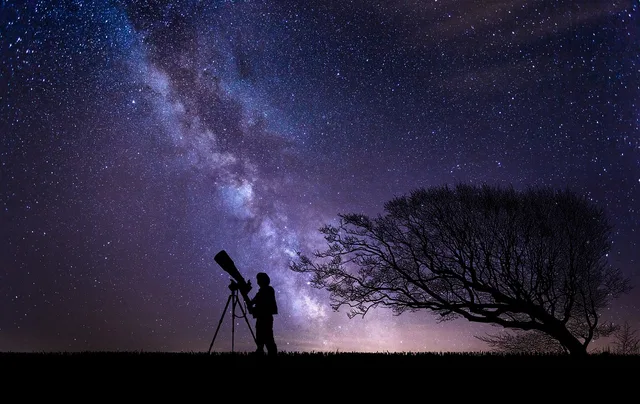
A telescope turns a flexible night into a committed one. You choose a spot, set up, and let the instrument settle to the outside temperature. Then you stay put for a couple of hours.
That helps if your plan allows it, and frustrates you if it does not. Good telescope trip planning means more time and fewer places.
What to take away
- Add an hour to every night for setup, cool down and pack down.
- Stay two nights in one place rather than one night in two.
- Learn one instrument properly instead of carrying two.
- Pick targets that reward patience, since patience is what the setup buys you.
Build the extra hour into the plan
The realistic sequence for a telescope night is: arrive and set up in daylight, let the instrument cool while you eat, observe once the sky is dark, then spend fifteen minutes packing carefully. That is roughly an hour more than a binocular night, every night.
Telescope night sequence
- Daylightarrive and set up
- Dusklet instrument cool while eating
- Darkobserve
- Endpack carefully, 15 minutes
The consequence is arithmetic rather than opinion. If your trip has four nights and you want three of them productive, you cannot also drive four hours each day. Cut destinations, not observing.
There is a second cost that does not appear on any schedule. Setting up in a hurry is how mounts get knocked, plates get dropped in long grass and eyepieces end up on the roof of the car.
Transit and setup damage is the usual way instruments die, which is why it heads the lines people forget when pricing a telescope weekend. Allowing a slow twenty minutes at the start of the evening protects the instrument as well as the night.
Match the trip to the Moon and to a certified site
Dates come before destinations. A telescope night wants the darkest sky you can reach, so aim for the nights around new moon, when the Moon is out of the evening sky. If the calendar will not cooperate, a waxing crescent is the next best thing: the terminator, the line between lunar day and night, is where crater detail is sharpest.
For the site, start with the International Dark Sky Places program run by DarkSky International, the organization that certifies dark-sky parks, reserves and communities. Cherry Springs State Park in Pennsylvania, Natural Bridges National Monument in Utah and Death Valley National Park in California are all certified, and they are the kind of place where a tripod and a slow setup are ordinary rather than strange.
Pack around the instrument: the mount, one or two eyepieces, a spare power supply for a go-to mount, a dew shield for damp sites, a red light to protect your dark adaptation, and a small table so eyepieces never touch the grass.
Two nights in one place
The first night at any site is partly a rehearsal: you learn where the horizon is blocked, where the ground is soft, and which direction the wind comes from. The second night is where the value is.
Two nights vs two sites
Two nights, one site
- Value gained
- High
- Packing
- Halved
- Rehearsal
- Night one
- Site knowledge
- Learned
One night, two sites
- Value gained
- Low
- Packing
- Doubled
- Rehearsal
- None
- Site knowledge
- Missed
Two nights at one site produces far more than one night at two, and it halves the packing and unpacking you do. Which stops can take an instrument at all, in terms of parking, ground and horizon, is set out in stops worth choosing once the telescope is in the car.
This is the same principle as the general slow planning approach in how to plan a night sky trip without rushing it, applied to an activity that punishes haste more sharply.
Choose targets that repay the setup
If you have set up your telescope, spend the night on something that rewards close attention. The Moon is the obvious candidate and is more varied than most beginners expect.
NASA's Moon facts page explains what the surface records about the history of the solar system. That makes an evening of crater work more interesting than just confirming that craters exist.
Faint, subtle objects are the other good use of a settled instrument. NASA's piece on the dim delights of Cancer covers a faint constellation that holds the Beehive Cluster, one of the sky's easiest and most attractive clusters.
It also explains how to find the cluster using brighter neighboring stars. A small instrument on a stable mount handles such targets well.
Leave room to stop
Set a finish time and hold to it, and build the trip so that stopping early costs nothing at all. That means a bed close by, a flexible booking, and nothing scheduled the next morning that anyone has to be awake for. The instrument you plan around should be one you can carry and set up alone, on a mount steady enough that you are not fighting it all night; choosing a travel telescope walks through the trade-offs.