Rules
Part of Handling dark sky trip case studies step by step: case two: the lunar eclipse that worked
Dark sky trip accessibility: three composite examples and the paved overlook
Three composite accessible night trip examples show why a paved overlook with nearby parking matters most and what to ask about distance, surface, seating, warmth.
What to take away
The real issue with dark sky trip case studies accessibility is the paved overlook. A paved overlook with parking beside it removes the transfer, the rough ground and the long walk. That single feature decides whether a wheelchair user, a person with limited stamina or a parent with a sleeping child can stay for two hours.
- A short transfer and a seated view solve most accessibility problems on a night trip.
- Somewhere warm within a few minutes extends the session far more than better equipment would.
- Choose targets that sit part way up the sky rather than directly overhead.
- Ask for measurements before booking and confirm them again shortly before traveling.
- Ask about the paved overlook first. It controls transfer, surface, seating and warmth at once.
- Named examples include Grand Canyon's Mather Point, Natural Bridges' Sipapu Bridge Viewpoint, Death Valley's Zabriskie Point, Bryce Canyon's Sunrise Point and McDonald Observatory in Texas.
Most dark sky case studies describe a site as accessible, then leave the reader to discover the gap. The gap is often the last 200 meters. A paved overlook with parking beside it closes that gap.
It gives a stable surface, a seated view from a car or bench, a warm retreat a few steps away and an open horizon.
Grand Canyon National Park's Mather Point has a paved overlook and a parking lot beside it. Yavapai Point adds indoor exhibits and restrooms. Natural Bridges National Monument, the first International Dark Sky Park, has paved overlooks along Bridge View Drive, including Sipapu Bridge Viewpoint.
Death Valley National Park, the largest International Dark Sky Park in the lower 48, has Zabriskie Point. The point has paved parking and a short paved walk to the view. Bryce Canyon National Park has paved viewpoints at Sunrise Point and Sunset Point, plus ranger astronomy programs.
Cherry Springs State Park in Pennsylvania has a designated astronomy field, but the field is grass. Ask about surface before you book. McDonald Observatory in Texas holds public star parties and has a visitor center, so it is another place to ask about paved access.
These three examples are composites, not interviews. They are assembled from arrangements that reliably work. In each one, accessibility was designed into the night rather than added to it. The transfer was short. The view worked from a seat. Somewhere warm sat within reach. The targets suited the observer, not the guidebook.
Example one: the paved overlook
A wheelchair user books lodging twenty minutes from a paved overlook. Parking sits beside it, and the southern view is open. Grand Canyon's Mather Point and Natural Bridges' Sipapu Bridge Viewpoint follow this pattern: pavement, parking within a few meters, and an open horizon.
No transfer, no rough ground. The car waits a few meters away as a warm retreat. The observer watches for two hours, fully comfortable, with a break in the middle to warm up instead of heading home.
Research by email weeks earlier did the work. The email asked about surface, gradient, distance from the parking space, and confirmation the gate stayed open at night. None of it appeared on any page describing the site. None would be discoverable on arrival in the dark.
Accepting the word accessible without asking for those measurements is the first of the mistakes that shut people out of a night sky.
Example two: the visitor center telescope night
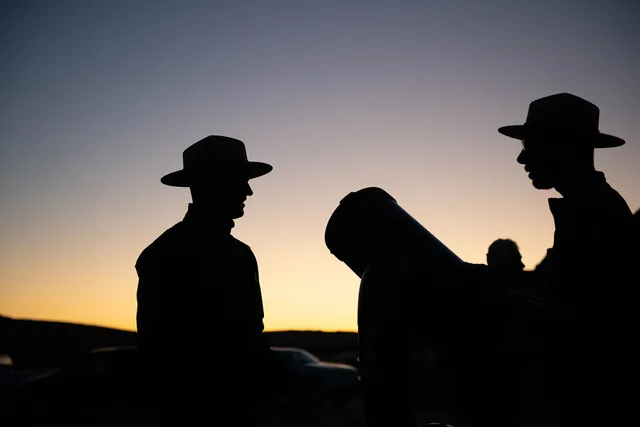
A group including someone with limited stamina attends a ranger telescope evening held on a paved area beside a building. Chairs are available, the walk is a few meters, there is a restroom and an indoor space to warm up, and the session ends at a stated time.
Bryce Canyon National Park runs ranger astronomy programs in summer. McDonald Observatory in Texas holds public star parties. Both use paved areas and buildings, so ask whether chairs are provided and whether the walk is short.
Events of this kind are often the most accessible night activity a region offers. They are rarely advertised as accessible. Ask directly what the surface and the walking distance are, and whether chairs are provided or should be brought.
Staff running a regular program usually know the answers immediately, because they have been asked before. That is one of the things the guided nights in this cluster had in common, a person who had run the evening often enough to answer without checking.
Example three: the garden, Altair and the Summer Triangle
A traveler who cannot manage a night out at all observes from a garden with a partial view of the sky. They work on bright stars and patterns rather than faint objects. There is plenty to do.
NASA's star basics shows the scale: the universe may hold up to a septillion stars, and our galaxy has more than a hundred billion, including the Sun.
Bright anchors make observing rewarding. They are least affected by a partial view or a nearby streetlight. NASA's piece on Altair describes the Summer Triangle corner that rises last for northern observers.
That star spins so fast it looks squashed. It sits high overhead at the end of summer. Learning three stars like that from a garden is a real achievement, not a substitute for one.
What to ask, every time
Check distance from parking, surface, and gradient. Confirm seating, restroom availability at night, and somewhere warm within a few minutes. Get it in writing, note the date, and check again in the week before you travel.
Ask about the paved overlook first. If the site has no paved overlook, ask what the last 200 meters are like. That answer decides whether the trip works.
The general version is in accessible dark sky travel, and the wider set of worked trips is in dark sky trip case studies.