Guides
Part of Dark Sky Travel: Darkness, Moon and Access
Dark sky travel: a two-night itinerary built around the sky, not the clock
A two-night stargazing plan set by sunset, moonrise and moon phase, with a daylight scout, a rehearsal night and a second night for real observing.
Two nights is the smallest useful dark sky trip. One night gives weather a single chance to ruin everything, and leaves you learning the site in the dark.
The shape below drops onto almost any destination, because it is timed by sunset and the Moon rather than by opening hours. It fits Grand Canyon South Rim in Arizona, Natural Bridges National Monument in Utah, and Cherry Springs State Park in Pennsylvania. In Canada, Jasper National Park is a dark sky preserve with the same two-night shape.
What to take away
- Arrive with two hours of daylight left, then drive the night route at night speed.
- Astronomical darkness lands about ninety minutes after sunset at mid-latitudes, later in summer.
- Moon phase decides which half of the night is worth staying up for.
- Night one is for learning the horizon, night two is for observing.
- Keep the drive from bed to site under about thirty minutes each way.
The arithmetic that sets the schedule
Sunset is not darkness. Full astronomical darkness arrives roughly ninety minutes after sunset at mid-latitudes, and longer in high summer. That window is the part of the night faint targets survive in, so it is the part you build around.
From sunset to full darkness
- Sunsetsky still bright
- 90 min laterfull astronomical darkness
- High summerdarkness arrives later
- Dark windowfaint targets survive
At Grand Canyon's latitude, 36 degrees north, How many dark hours each month gives you shows about 5 hours 40 minutes in June and 11 hours 10 minutes in December.
Then the Moon. NASA's daily Moon guide gives phase and appearance for any date, which tells you whether your dark window falls early or late.
Gear the plan assumes
- Red light headlamp or flashlight, because white light resets your night vision.
- Warm layers, including a hat and gloves, because desert nights fall fast.
- Binoculars, 7x50 or 10x50, on a strap.
- A folding chair or a blanket, so you can sit still for hours.
Worked example: Grand Canyon in a time-zone trap
Grand Canyon publishes sunrise, sunset and moon phase tables for the year. Use them rather than a phone app that guesses your zone.
Grand Canyon time-zone checklist
- Read official sunrise, sunset, moon tables
- Note Arizona stays on Mountain Standard Time
- Add one hour if arriving from daylight saving
- Write down when sky goes fully dark
- Write down moonrise or moonset time
Most of Arizona stays on Mountain Standard Time all year. Visitors arriving from a daylight saving state are often an hour out, which is the difference between setting up in twilight and setting up in the dark.
Read the table, note the offset, and write the two times you actually need on paper: when the sky goes fully dark, and when the Moon rises or sets.
For June 21, the South Rim tables list sunset at 7:45 p.m. MST. Full astronomical darkness arrives at 9:36 p.m. MST. Moonrise is at 1:50 a.m. MST. That leaves a dark window of about 4 hours 15 minutes before the Moon.
On December 21, sunset is 5:15 p.m. MST and full darkness is at 6:51 p.m. MST, so the dark window runs about 11 hours.
Night one: scout and rehearse
Afternoon. Arrive with two hours of light left. Drive the exact route you will use after dark, at the speed you will really drive it. Mark where you can pull over and where there is no shoulder.
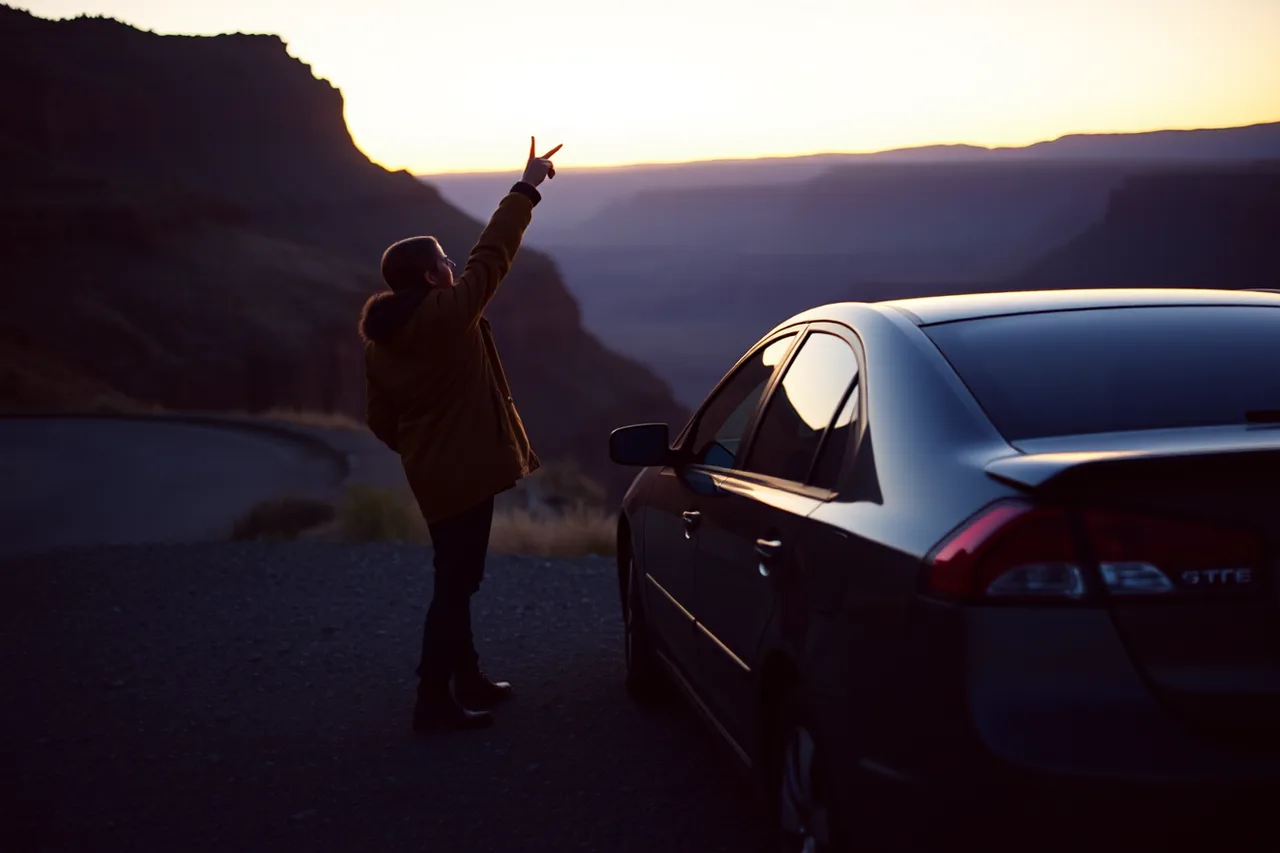
Sunset. Stand on your chosen spot and read the horizon. Which way is the nearest town, and how much glow does it throw? Where is south, and is anything tall blocking it? A ridge behind you helps. A ridge in front of you does not.
First dark. Spend the first hour without optics. Twenty minutes with no white light gets your eyes most of the way there. Find the Big Dipper, find the North Star, then just watch. Meteors and satellites arrive on their own.
Late. Stop before you are tired.
Night two: observe
Morning. Sleep in. This is a schedule that runs late twice, and skipping the lie-in is how people end up driving badly.
Afternoon. Do the daytime version of the destination, but keep it short. Save your legs for the night.
Evening. Eat early, dress before you feel cold, and be in position before darkness rather than after it. Bring out the binoculars or the telescope now, because you already know where to point them.
Finish. Set a hard end time before you start and keep it. What two nights at Grand Canyon South Rim cost, including a room in Tusayan and park entry, is broken down in dark sky travel costs.
When the Moon or the cloud changes the plan
A full Moon inverts the shape. Use the bright hours for walking and lunar viewing, and hold faint targets for the stretch before moonrise. The camping version of this two-night plan for Natural Bridges is arranged that way from the start.
If cloud arrives, drive to the other side of a ridge before you drive home. If someone tires early, split the group and let one car leave. For a list of dark sky parks with lodging and permit rules, see dark sky travel in 2027.
Common questions
Why two nights and not one?
One night gives weather a single chance to ruin the trip and no time to learn the site.
How long after sunset is it truly dark?
About ninety minutes at mid-latitudes, longer in summer and shorter near the equator. Check the figure for your latitude and date rather than assuming.
Should I drive somewhere new on night two?
Only if the sky forces it. Familiar ground is faster and safer after dark, and you already know where the glow and the obstacles are.
What if the Moon is bright?
Use it. Walk, look at the Moon itself, and keep faint targets for a trip with a darker window.