Guides
Camping at US Dark Sky Parks: Which Ones Allow Campfires?
Which US dark sky parks let you have a campfire while camping: fire rules for Big Bend, Death Valley, Great Basin, Cherry Springs, and Natural Bridges.
What to take away
- Big Bend, Death Valley, and Great Basin allow wood fires in named campground fire rings.
- Death Valley's Wildrose, Thorndike, and Mahogany Flat have no rings, so wood fires are banned.
- Cherry Springs State Park allows fires in its campground rings, with a firewood quarantine.
- Natural Bridges allows fires only in cement grills at its campground.
- A site far outside the gate costs three hours of dark sky on a clear night.
The question that decides your booking is not which park has the darkest sky. It is whether the campground lets you burn wood, because that answer shapes what you pack, what you cook on, and how late you stay up.
Park by park fire rules
| Park or campground | Fire rule to know |
|---|---|
| Big Bend National Park, Texas | Wood and charcoal fires allowed in grills at Chisos Basin, Rio Grande Village, and Cottonwood Campground. No wood gathering. |
| Death Valley National Park, California | Fires in rings at Furnace Creek, Stovepipe Wells, and Mesquite Spring Campground. Wildrose, Thorndike, and Mahogany Flat have no rings, so wood fires banned; use a stove. |
| Great Basin National Park, Nevada | Fires in designated grates at Lower Lehman Creek, Upper Lehman Creek, Baker Creek, and Grey Cliffs Campground. No wood gathering. |
| Cherry Springs State Park, Pennsylvania | Wood fires allowed in campground fire rings. Bring local or heat-treated firewood due Pennsylvania's firewood quarantine. |
| Natural Bridges National Monument, Utah | Fires allowed only in cement grills in the campground. No wood collection. |
These rules are current as of this writing. Check the Superintendent's Compendium before you book, because burn bans can change a site from fire allowed to stove only in a dry week.
Campfire rules by dark sky park
Big Bend
- Wood fires
- Grills only
- Charcoal
- Grills only
- Wood gathering
- Banned
- No-ring sites
- None listed
Death Valley
- Wood fires
- Rings only
- Charcoal
- Rings only
- Wood gathering
- Banned
- No-ring sites
- Stove only
Great Basin
- Wood fires
- Grates only
- Charcoal
- Grates only
- Wood gathering
- Banned
- No-ring sites
- None listed
Cherry Springs
- Wood fires
- Rings allowed
- Charcoal
- Not stated
- Wood gathering
- Bring local wood
- No-ring sites
- None listed
Where to find each park's legal fire rule
Every National Park System unit publishes a Superintendent's Compendium stating where fires are allowed. The National Park Service night sky pages link out to individual parks, putting fire rules one click from the dark sky listing.
How to find the legal fire rule
- Open the park's Superintendent's Compendium
- Check the NPS night sky page for the park link
- Confirm the rule for your specific campground loop
- Assume steel ring or grill only in developed sites
- Expect wood bans at dry high-elevation sites
- Never gather dead wood or move a fire ring
Most developed campgrounds allow fires only in the steel ring or grill on site. Higher-elevation campgrounds often ban wood fires when fuels are dry.
Two rules follow: most parks ban gathering dead wood, and you cannot move a fire ring. Leave No Trace treats fire as one of the longest-lasting impacts a camper leaves, which explains why wood collection is restricted so tightly.
A ban moves your money toward fuel and camp-store prices. The stargazing travel mistakes cost breakdown shows where that spend lands.
The approach-road campground is the wrong choice
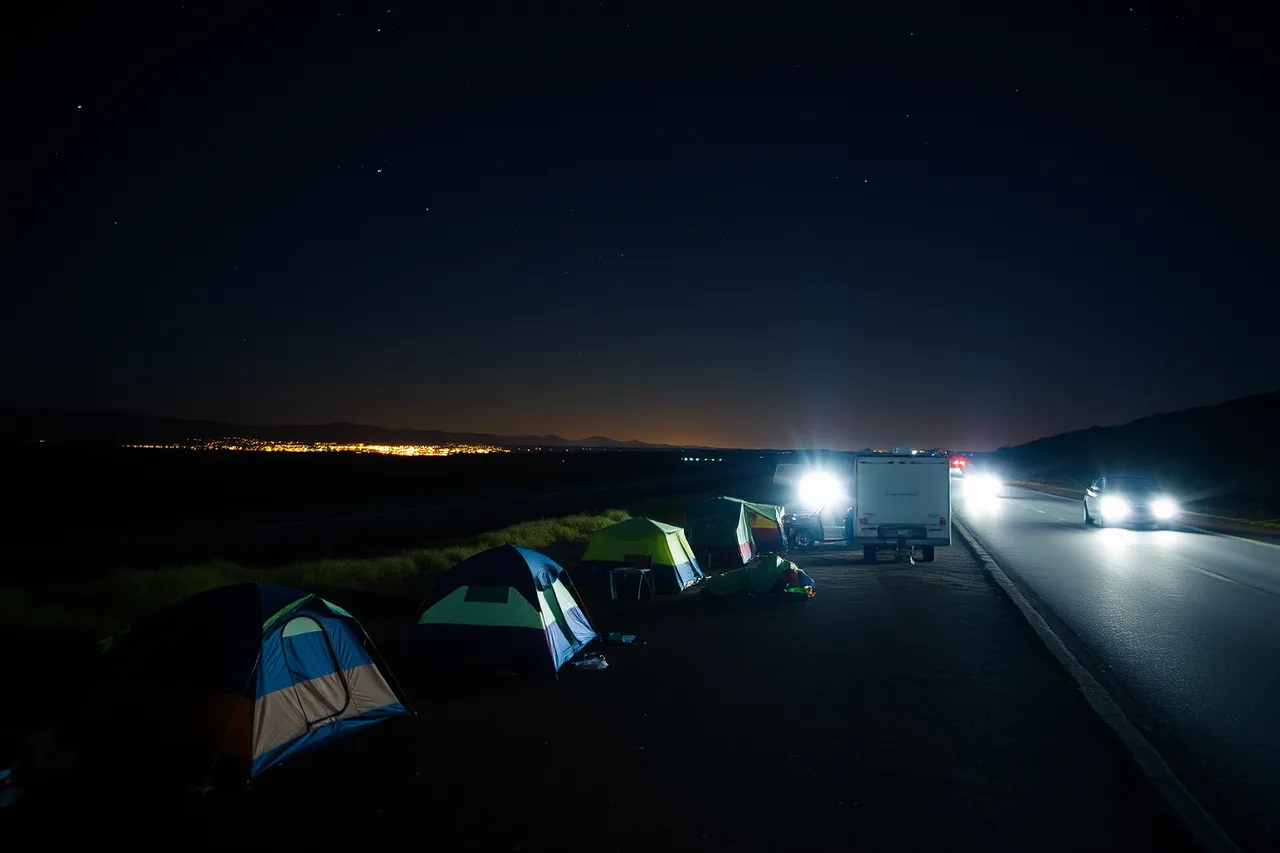
Campgrounds strung along the highway outside the park boundary look convenient and are the wrong choice. Headlights cross your site after midnight. Town glow sits low on the horizon exactly where you want to look. You still drive into the park for darkness, so the cheaper site buys you nothing. Motels with floodlit parking lots carry the same problem.
Where camping works: in-park loops, tent sites, primitive zones
Where camping works
- In-park developed campgrounds. Fires in rings where the compendium allows them, plus water, toilets, and a short walk to the darkest sky in the park.
- Walk-in and tent-only loops. Fewer generators and no RV exterior lighting, which are the lights most likely to reach your eyes.
- Primitive and backcountry zones. Wood fires are often banned outright, so you carry a stove and gain the darkest sky of the trip.
Casual stargazing from a pullout usually needs no permit, as Big Bend's stargazing page makes clear. The permit question appears only for organized events and commercial photography.
If you would rather sleep in a bed, the dark sky lodging field list covers what to ask before you confirm a room.
What to check before booking
- Fire rules for that specific loop, not the park as a whole
- Whether wood or charcoal can be bought within 30 minutes
- Generator hours and any quiet-hours rule
- Water and toilet status, since some loops shut them off in winter
- Whether the site sits under a light or beside a restroom
Ask the fee booth what happens when a burn ban drops mid-stay. Staff will tell you whether cook stoves stay legal and whether charcoal counts as wood under that park's rule.
Travel time from campground to the sky site
| Campground zone | One-way drive | Round trip |
|---|---|---|
| Loop inside the park gate | 10 to 25 minutes | 20 to 50 minutes |
| Campground outside the boundary | 30 to 60 minutes | 1 to 2 hours |
| Gateway town lodging | 45 to 120 minutes | 1.5 to 4 hours |
Figures above are illustrative for planning, not a substitute for current park maps or gate hours.
Round-trip driving eats the middle of a short summer night. At a mid-latitude park in June, astronomical darkness can last only a few hours, so 90 minutes each way can cost you most of the window. The guide to Find Bortle 1 Skies treats that drive as the deciding variable.
Booking lead times
Reservation windows vary. The busiest parks open sites about 6 months ahead, while others release inventory 2 weeks to 4 months out. New-moon weekends in summer go first. If you miss the opening, watch for cancellations 2 to 4 weeks before arrival and again in the final 48 hours. Can you shift to a Tuesday instead of a Saturday?