Industry
Part of Dark Sky Lodging: Five Outdoor Lighting Questions to Ask Before Booking
Dark Sky Lodging Businesses: Lighting and Guest Briefing
How dark sky lodging businesses protect the night: NPS lighting principles, shielded warm fixtures and timers, guest briefings, the Moon and certification.
A property that sells a dark sky has an unusual commercial position. The product is degraded by the property's own lighting, and by the lighting of every neighbor within a long radius. That makes lighting a shared asset rather than a private decision. It gives dark sky lodging businesses a reason to act together that has nothing to do with goodwill.
What to take away
- The property's own fixtures are the first and cheapest thing to fix.
- Guest habits matter as much as hardware, and check in is where they are set.
- Certification for a place is a community process with measurable requirements.
- Measurement turns a claim into evidence you can show a guest.
Fix the property first
The retrofit list is short and mostly one time:
- Ask of every fixture whether it needs to exist at all; reflective tape or paint can mark a path edge or step without any light.
- Shield every outdoor fixture so the source is not visible from a distance.
- Aim light down at paths and steps rather than out across the grounds.
- Choose warmer color temperatures instead of cold blue white.
- Put decorative and sign lighting on timers that end at a set hour.
- Use motion sensors on service areas rather than lighting them all night.
- Leave one part of the grounds genuinely unlit, and tell guests where it is.
An operator does not have to invent these standards. The National Park Service publishes outdoor lighting principles for its own lodges, campgrounds and visitor centers, and illustrates them with a lighting retrofit at Stovepipe Wells Hotel in Death Valley National Park. The principles turn the list above into specifications a contractor can quote against:
- Fully shielded fixtures.A fully shielded or full cut-off fixture sends light down onto the task area and not into the sky, with the bulb recessed so none of it is visible at eye level. Globes and diffusers that hang below the fixture, and floodlights aimed sideways, should go.
- Light only where and when needed.Pick the mounting height and light distribution so light does not spill beyond the path or step it serves, and fit timers, motion detectors and dimmers.
- The lowest output that does the job.Specify light output in lumens rather than watts, and choose the lowest that lights the task safely.
- Warm color.The NPS says 2700 Kelvin can give excellent color rendition while minimizing unintended impacts, and that 2200 Kelvin or amber options may suit sensitive environments. LEDs above 2700 Kelvin emit more blue light, which can cause glare and spoil dark-adapted vision.
The same principles list astronomy-based tourism among the benefits of well-designed lighting, which is the case a dark sky lodging business makes to its neighbors.
The scale of the problem justifies the effort. Great Basin National Park's page on its lightscape notes that two thirds of Americans cannot see the Milky Way from their own backyards. Nearly everyone lives with measurable light pollution.
A property that has kept its patch dark offers something most guests cannot get at home. Say so plainly in the listing rather than leaving it to a stock photograph of a starry sky. Where the listing goes further and sells a stargazing package, guests will unbundle the room from the guided hour before they compare prices.
Brief the guests
Hardware only gets you so far if visitors leave porch lights burning and swing headlights across the grounds at midnight. What works is a short, friendly briefing at check in, and a card in the room:
- Please keep porch and window lights off after dark.
- Use the red light provided rather than a phone torch.
- Park facing away from the viewing area, and use parking lights when leaving late.
- If you arrive after dark, dip your headlights on the final approach.
A rule that arrives with a reason is easier to keep: guests booked the property for the sky, and the briefing explains that one porch light left on spoils the grounds for everyone else out there. It also lets an operator fairly ask a late arrival to dim their lights. That request is much harder to make politely if no one heard the rule at check in.
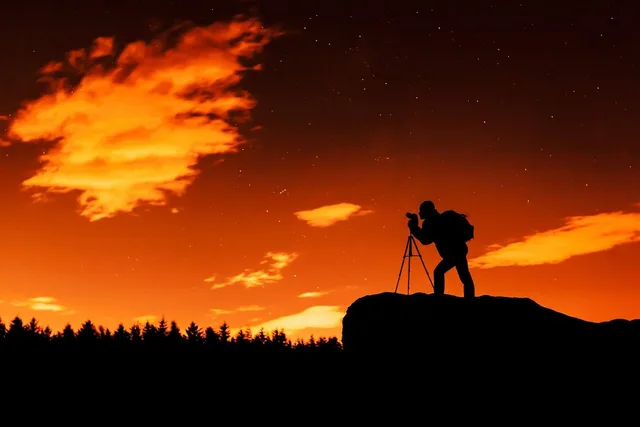
Photographers are the guests most likely to be out on the grounds at two in the morning. It is worth knowing what they need from a property before they ask for it.
The Moon sets the stakes
On the nights around a new moon the sky is as dark as it ever gets, and that is when a single porch light or a sweep of headlights does the most damage: there is no moonlight to hide it. On the nights around a full moon the sky is bright enough that the fixtures matter far less, and guests are often surprised by how much of the grounds they can see.
Say which nights are dark on the property's calendar, and say it at check in rather than in a welcome folder. A guest who books a full-moon weekend expecting a black sky is the guest most likely to leave disappointed, and the briefing is the cheapest place to reset that expectation.
Join the community effort
Certification is granted to places, and the process is measured, not declared. The International Dark Sky Park designation is awarded by DarkSky International, the organization formerly known as the International Dark-Sky Association. It is one of five types of International Dark Sky Place: Sanctuaries, Parks, Reserves, Communities and Urban Night Sky Places. A lodge usually sits inside or beside one of these rather than holding a designation of its own, so the town's Community application or the neighboring park's application is where it can help. El Malpais National Monument describes its own route on its night skies page, and the park is applying to become an International Dark Sky Park.
The application requires proving its skies are dark enough to qualify, and it calls for sky brightness measurements and a lighting management plan for the site. Certification also aims to encourage neighboring communities to help protect the night.
That is the opening for a business, and lighting upgrades at nearby properties support a park or community application. An application in progress gives a town a shared project rather than a set of individual gestures.
The wider argument for all local businesses is in how local businesses can support stargazing trips. The guest side is in our guide to choosing dark sky lodging.