Guides
Part of Evidence checklist for stargazing trip costs: spending that rarely pays
Stargazing trip costs itinerary: a two-night breakdown
This stargazing trip costs itinerary breaks down a two-night camping budget, including campsite nights, fuel and groceries, and explains why night two matters.
This stargazing trip costs itinerary lays out the cheap version of a two-night trip, for someone who wants the sky, not the trimmings. It assumes a campsite, your own food, one tank of fuel, and no purchases beyond warm clothing.
It also assumes something people usually treat as bad luck: one of your two nights will have a bright Moon or poor weather. It plans a use for that night.
What to take away
- Camp at the site. It removes the largest line and the longest drive at once.
- Give the bright or cloudy night a job instead of writing it off.
- Cook and eat before dark, because late food is where budgets quietly fail.
- Spend nothing on optics until after the second night.
Before you go
Choose a site with a campground and a dark horizon, within one tank of driving each way. Book the campsite as early as you can; cheap spots go first. Check access rules with the land manager. Natural Bridges National Monument is managed by the National Park Service, so check its rules there; our permit for overnight parking guide can help you check whether a permit applies.
Before You Go Checklist
- Sitecampground and dark horizon
- Within one tank of driving each way
- Book campsite early; cheap spots go first
- Check access rules and permits
- Check Moon for both nights
- Pack no-cook food and hot drink flask
- Fill tank before last fuel town
- Download area map while signal lasts
Check the Moon for both nights, and decide in advance which night is the dark one. Use the U.S. Naval Observatory’s Moon Phases service to check the dates before booking, and aim for the night with the least moonlight.
Pack food that needs no cooking after dark, plus one hot drink flask per person. Buy nothing else. Warm layers you already own will do, and a folded blanket beats a bought seat pad. Cutting the layers to save money is the one economy that reliably backfires, and it heads the list of costs first-timers get wrong.
Fill the tank before you leave the last town with fuel, and download the map for the area while you still have signal.
Both take five minutes. They remove the two most expensive mistakes on a trip like this: a fuel detour that eats an hour of darkness, and a wrong turn on an unlit road at midnight.
Day one, the bright or uncertain night
Arrive with daylight to spare, walk the site and note where you will sit, where the horizon is clear and where the ground is uneven. Arriving in daylight is free and protects the campsite night you have already paid for.
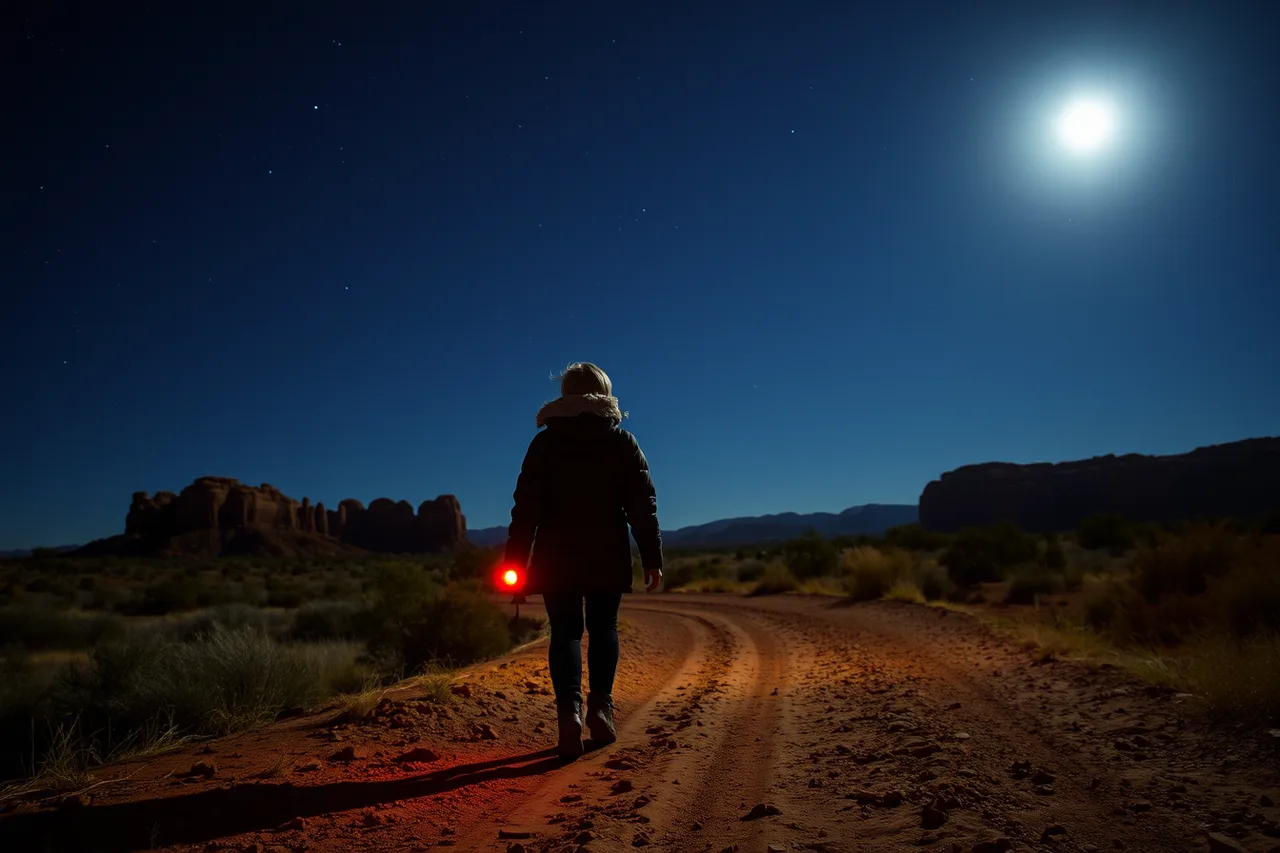
If the Moon is up, use it: NASA's page on moonlight notes that moonlight is reflected sunlight, which floods the sky and drowns faint objects.
It does not drown the ground. A moonlit walk on an easy trail costs nothing and saves a drive to a second site in search of darker sky.
Natural Bridges National Monument's stargazing page notes that half the park is after dark.
A night hike and stargazing make a quieter visit, and even with a full Moon lighting the sandstone, the skies stay excellent. One site that gives both saves the fuel a second destination would cost.
Natural Bridges National Monument is designated an International Dark Sky Park by the International Dark-Sky Association, now DarkSky International.
Day two, the dark night
Sleep late. Keep the daytime short: one walk, no summit attempt, no long drive. A short day saves fuel and keeps you awake for the night you paid for.
Get in position before darkness, not after, so the campsite night you have paid for starts on time. Spend the first twenty minutes with no white light at all.
Then work through the sky slowly; without optics you can still find the Milky Way, satellites, meteors, and several bright planets, and that costs nothing. Set a finish time before you begin; camping saves money, but a tired drive the next morning can easily lose it.
What this itinerary costs
Fuel, two campsite nights, and groceries. That is the whole list.
Typical figures for a two-night trip within one tank of home:
| Line | Typical cost |
|---|---|
| Campsite, two nights | $40 to $70, based on $20 to $35 a night at most public campgrounds |
| Fuel, round trip | $35 to $60 for a 250 to 350 mile round trip |
| Groceries | $40 to $60 for two people over two days |
| Total | $115 to $190 |
Campsite fees vary by state and by season, and groceries depend on how much you bring from home. Fuel depends on your round-trip distance and on local pump prices.
Groceries are estimated at $40 to $60, bringing the two-night total to $115 to $190: $40 to $70 for the campsite, $35 to $60 for fuel, and $40 to $60 for groceries. The second night accounts for $20 to $35 of the campsite cost; fuel and food cover the whole trip. The dark night is the centerpiece, but it is not the whole bill.
A fuller version of the same trip, with two motel nights and restaurant meals, typically adds $200 to $350 for lodging and $80 to $150 for food. The delta is about $280 to $500 over the two nights.
The comparison with a fuller version of the same trip is in our stargazing trip price guide, and the more comfortable two-night structure is set out in our two-day dark sky itinerary.